
Canada Tightens Rules for Hiring Foreign Workers: What Employers Need to Know in 2025

Updated: Sep 1, 2025
If you’re an employer in Canada thinking about bringing in talent from abroad, be warned: the road just got bumpier.
The Temporary Foreign Worker Program (TFWP) — a lifeline for industries like aviation, healthcare, hospitality, manufacturing, STEM, and restaurants — has introduced new rules that make getting a Labour Market Impact Assessment (LMIA) much harder.
Here’s what’s changed, and why you need to start planning now.
💰 1. Higher Wages Across the Board
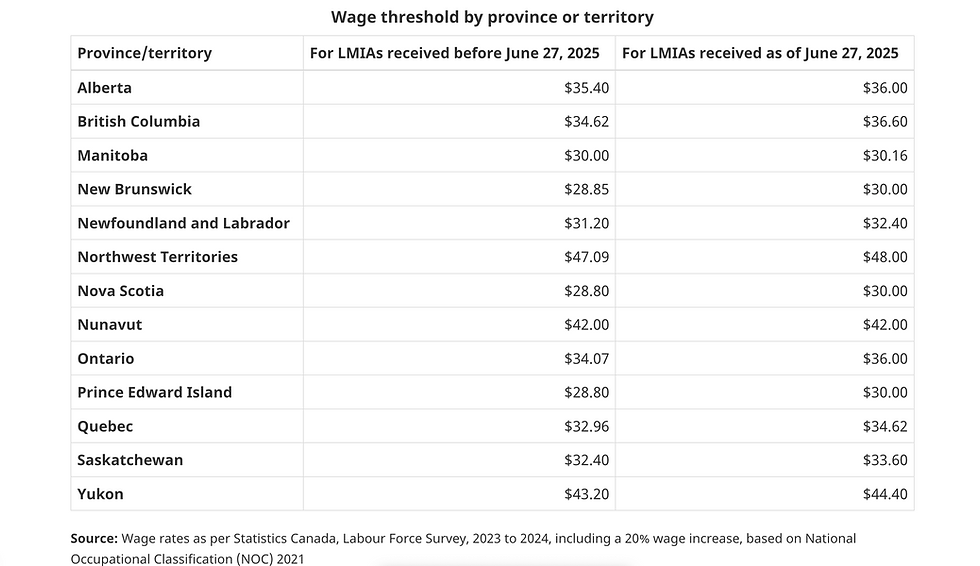
To qualify for a high-wage LMIA, you now need to offer salaries above new provincial median rates. A few examples:
· Ontario: Now $36.00/hour (up from $34.07)
· British Columbia: Now $36.60/hour (up from $34.62)
· Quebec: Now $34.62/hour (up from $32.96)
If your company has a flat pay scale for similar roles, these increases can cause internal pay equity headaches.
🚫 2. Fewer Options for Low-Wage LMIAs
As of July 11, 2025, more communities experienced an unemployment rate of 6% or more. If your local unemployment rate is 6% or higher, you’re out of luck for the low-wage stream.
Example: Moncton, NB now exceeds the 6% mark, meaning employers there must pay at least the provincial median wage — or higher if the job’s specific median is above that.
These rates are reviewed every quarter, with the next update on October 10, 2025.
🧐 3. More Justification Required
Service Canada officers want clear, detailed explanations for:
· Why no Canadian or permanent resident was hired
· Why certain experience or education is essential
· Why the foreign candidate is the best fit
📑 4. Paperwork Overload
Even large, reputable employers must now provide:
· CRA tax filings
· Payroll records and proof of financial capacity
· Contracts, project plans, forecasts
· Bank attestation letters (a problem since many banks, like BMO, won’t issue them)
🔍 5. Microscopic Recruitment Reviews
Expect officers to ask for:
· A candidate-by-candidate breakdown of all applicants
· Detailed reasons for rejecting each domestic candidate
Why This Matters for Renewals
If you’ve got foreign workers with expiring permits — especially international graduates — it’s now harder to extend them via LMIA. Higher wages, extra paperwork, and tougher justifications are all in play.
How Employers Can Adapt
Before you start an LMIA application in 2025:
1. Check local unemployment rates where the job is based.
2. Look up median wages on the Job Bank.
3. Budget for wage increases to stay compliant.
4. Prepare airtight recruitment records and justifications.
5. Plan for the worker’s long-term pathway (permanent residence can be a strong argument).
6. Talk to immigration professionals before filing.
7. Explore alternatives like the International Mobility Program (IMP).
8. Time your application carefully — waiting for better conditions may make sense.
The takeaway? In 2025, the LMIA process is not just about proving you need a foreign worker — it’s about proving you’ve left no stone unturned in finding a Canadian, paying top wages, and having the paperwork to back it up.
If you are ready to embark on the LMIA application process, contact us so we can support you through this rigorous application exercise.

Comments