
Ontario’s New ESA Job-Posting Rules and Their Impact on LMIA Recruitment Under the Temporary Foreign Worker Program

Effective January 1, 2026, Ontario’s amendments to the Employment Standards Act, 2000 (ESA) introduce new requirements for publicly advertised job postings. Although framed as employment-standards reforms aimed at transparency and fairness, these changes have direct and material consequences for employers recruiting under the federal Temporary Foreign Worker Program (TFWP), also known as the particularly a Labour Market Impact Assessment (LMIA) stream.
For Ontario employers, LMIA recruitment can no longer be treated as a purely federal exercise. Provincial job-advertising compliance will increasingly form part of the evidentiary landscape assessed by Service Canada officers when evaluating whether recruitment was genuine, transparent, and conducted in good faith.
Why ESA Compliance Now Matters for LMIA Recruitment
Most LMIA applications (both high-wage and low-wage) require employers to demonstrate reasonable efforts to recruit Canadians and permanent residents before offering a position to a foreign worker. Those efforts typically rely on public advertising, including postings on the national Job Bank and additional recruitment platforms.
Because Ontario’s new ESA rules apply to publicly advertised job postings, they will often apply to the same advertisements relied upon to support an LMIA application. As a result, ESA-non-compliant postings now present a real risk to the success of an LMIA application, even where federal advertising requirements are otherwise met.
Pay Transparency and Wage Consistency
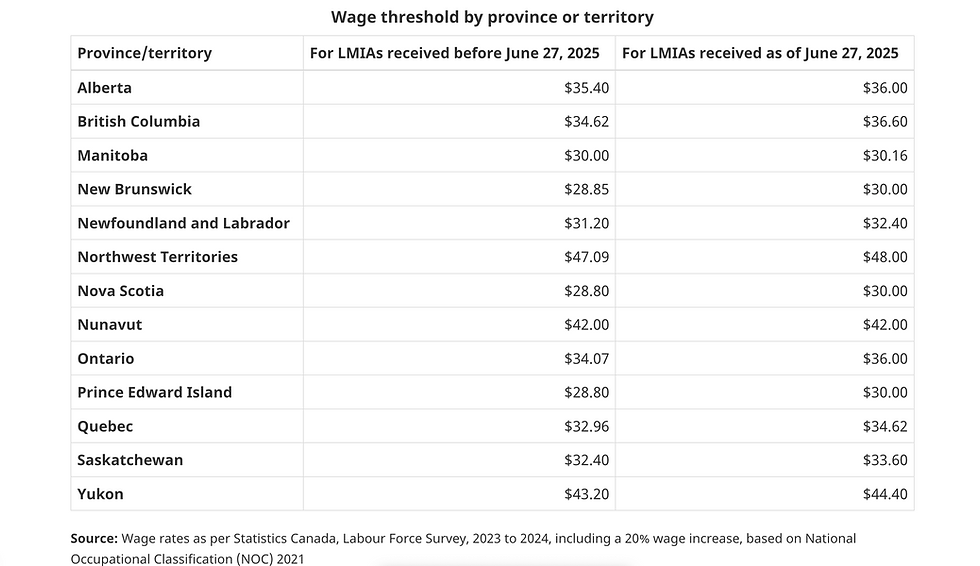
Ontario now requires job postings to disclose expected compensation or a compensation range, subject to limits on how wide that range may be. Federally, LMIA rules already require wage disclosure and strict alignment with prevailing wage data.
For LMIA purposes, employers should expect closer scrutiny where wage ranges are unusually broad. Where an employer maintains a wide wage range for employees within the same occupation, the employer should be prepared to provide a clear, evidence-based explanation of occupational or role-based differences that justify the range.
This may include distinctions based on seniority, scope of responsibilities, supervisory duties, specialized skills or credentials, or market-based compensation differentials supported by objective data.
Prohibition on Canadian Experience
Ontario’s ban on requiring Canadian experience will make the LMIA application process more challenging for certain hires. It remains permissible to require Canadian education, training, or lawful professional credentials where genuinely connected to the role.
Regulated Professions and Licensing Requirements
For regulated professions and occupations, Ontario’s new job-posting rules do not eliminate the need to include lawful Canadian licensing or certification requirements. Where licensure is a legal prerequisite to employment, it must be clearly and accurately reflected in the advertisements used to support a LMIA application.
Vacancy Disclosure and Replacement Scenarios
Neither the ESA nor Ontario guidance meaningfully defines what constitutes an existing vacancy. This creates risk for LMIA-based extensions or other work permit extension cases.
This ambiguity places employers in a legally uncertain position. We recommend that the start date of the position be clearly indicated as of the date the incumbent’s work permit expires, or at a slightly earlier date where there is a legitimate operational need for the incumbent to train a new hire. Employers should also be aware that LMIA approvals have become more difficult to secure, and there is no assurance an LMIA will be granted, even where all advertising and recruitment requirements have been fully complied with.
Job Bank Structural Limitations
As of the date of this blog, the national Job Bank does not include a dedicated field requiring employers to state whether a posting is for an existing vacancy, although it does include a mandatory AI disclosure field. The new ESA requirements also require employers to disclose whether AI is being used to evaluate applicants in all job postings.
Conclusion
Ontario’s ESA job-posting amendments materially alter LMIA recruitment requirements.
Provincial ESA compliance is now integral to demonstrating the whether the employer is offering a true vacancy or simply going through the motions to retain an existing employee or hire a specific candidate.
Employers looking to ensure that advertisements meet the legal and policy requirements of the Temporary Foreign Worker Program should consult counsel before filing an LMIA application.

Comments